
Buying
Look Beyond the Rate-What could waiting cost you?
 Frank EllerbroekMortgage Broker · NMLS #128726Vantage Mortgage Brokers · NMLS #35986Published 6 min read
Accessibility
Buying
Frank EllerbroekMortgage Broker · NMLS #128726Vantage Mortgage Brokers · NMLS #35986Published 6 min read
In investing, opportunities sometimes appear when other people step back. Homebuying can work the same way.
When mortgage rates fall, buyers often feel more comfortable entering the market. But when more buyers compete for the same homes, that lower rate can come with a different price: multiple offers, higher purchase prices, and sellers who have little reason to help with closing costs.
When rates rise, many buyers pause. That is understandable. Higher rates mean higher payments, and affordability matters.
But fewer competing buyers can also create opportunities: more time to evaluate a home, more negotiating room, and sellers willing to discuss price reductions or financial concessions.
The market that feels less comfortable to enter may offer a more favorable purchase opportunity—if the numbers work for you.
It is natural to want to buy when the headlines sound encouraging and everyone else is buying. The challenge is that other buyers are responding to those same signals.
A lower rate can improve your borrowing power. It can also improve everyone else’s.
If demand increases faster than the supply of homes, buyers may find themselves competing over price, accepting fewer concessions, or compromising on the home they want.
In a slower market, the balance can shift. Where inventory builds and homes take longer to sell, sellers may become more willing to negotiate:
A lower purchase price.
Credits toward closing costs and prepaid expenses.
Funding for a temporary payment buydown.
Discount points to reduce the mortgage’s interest rate.
Repairs or other contract terms that matter to the buyer.
These conditions vary by neighborhood and price range. Higher rates alone do not guarantee a buyer’s market, especially where homeowners are reluctant to sell and give up existing low-rate loans.
Still, a lower rate and a better purchase opportunity do not always arrive together.
Let’s compare buying today with waiting for a lower rate.
For this illustration, assume you purchase a $600,000 home, put $100,000 down, and finance $500,000 with a 30-year fixed mortgage at 7.375%.
The monthly principal-and-interest payment would be approximately $3,453.
Now assume the home appreciates 3% annually. This is an illustrative planning assumption, not a prediction or a claimed average for your local market. Actual values may rise, remain flat, or fall.
Here is how the purchase could develop with scheduled payments and no extra principal payments:
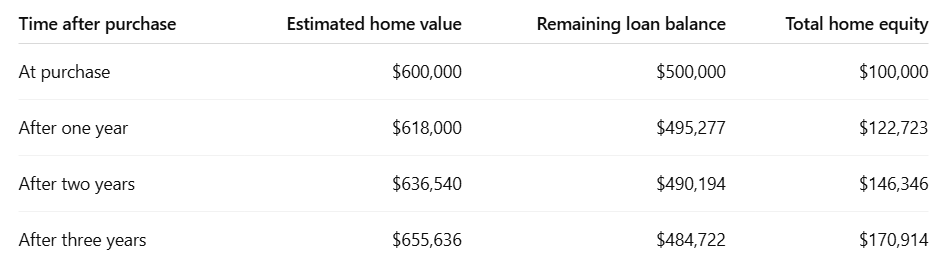
After three years, the buyer would have approximately:
$55,636 in appreciation.
$15,278 in principal paid down through monthly payments.
$70,914 in additional equity beyond the original down payment.
Appreciation increases the home’s value. Principal payments reduce the debt against it. Together, they can build equity over time.
That equity is not the same as profit. Principal paydown comes from money the homeowner pays, and ownership involves interest, taxes, insurance, maintenance, and transaction costs.
Imagine another buyer waits three years and then obtains a 6% rate. Under the same appreciation assumption, the comparable home now costs $655,636.
Keeping the down payment at $100,000, that buyer would need a loan of approximately $555,636.
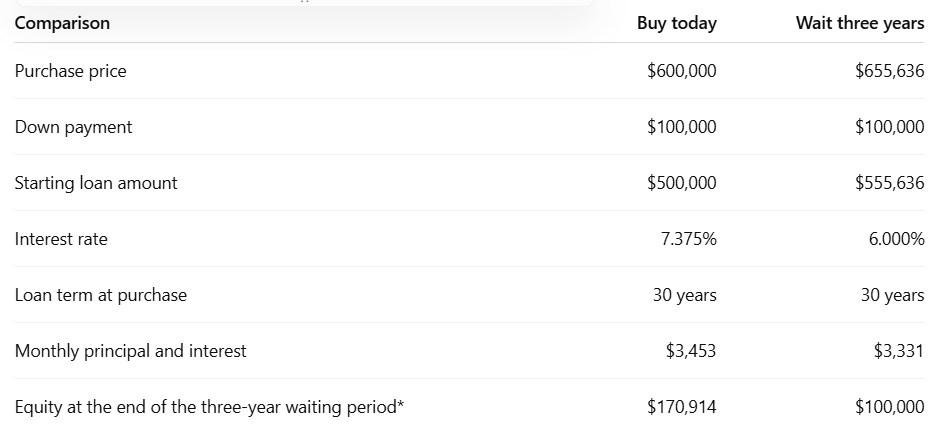
For the waiting buyer, equity is measured immediately after purchasing at the end of year three.
The waiting buyer gets a rate that is 1.375 percentage points lower, but the principal-and-interest payment is only about $122 less per month.
Why? Because the lower rate applies to a larger loan.
Meanwhile, the earlier buyer has approximately $70,914 more home equity at that point.
For the waiting buyer, that is a potential missed equity-building opportunity—not money literally lost from an account. The waiting buyer still retained the down payment during those years and may have earned investment returns or accumulated additional savings.
A complete comparison must also consider rent paid while waiting versus the full cost of owning. This example shows why the interest rate alone cannot tell you which choice is financially stronger.
The future price of the home matters considerably.
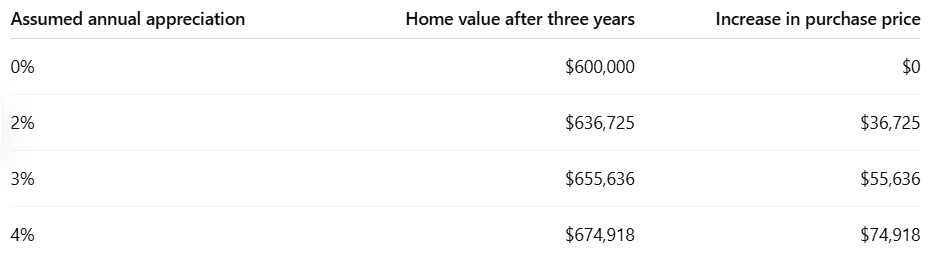
If prices stay flat, waiting for a lower rate could look more attractive. If prices decline, waiting could improve both the price and financing. If prices rise, some or all of the benefit of a lower rate may be offset by a higher purchase price.
Waiting has a potential cost, just as buying has a cost. Both deserve to be measured.
Your mortgage is a tool that helps you purchase and carry the home. It deserves careful selection, and it can be reviewed as your circumstances change.
You may choose financing that works today and later replace it through refinancing if another option provides a meaningful financial benefit.
But the rate is only temporary if an appropriate opportunity to replace it actually becomes available. A fixed-rate mortgage could remain in place for its full term.
That is why I would never recommend buying a home you can afford only if rates fall.
Before switching tools, we need to review the new rate, closing costs, remaining balance, loan term, and how long you expect to keep the financing. Restarting a 30-year term can lower the payment while extending the repayment period.
For perspective, the earlier buyer’s approximately $484,722 balance could have a principal-and-interest payment of about $3,025 at 6% over the remaining 27 years, before refinance costs. That is a hypothetical comparison, not a promise that the rate or refinancing will be available.
The approach is straightforward: choose financing you can comfortably carry today, then evaluate better tools when they become available.
A seller who has fewer buyers to choose from may be willing to contribute toward the buyer’s financing costs.
A temporary buydown uses funds set aside at closing to subsidize the buyer’s payments for an initial period. The mortgage’s note rate remains unchanged. For Fannie Mae loans, the buyer must qualify at the full note rate, without relying on the temporarily reduced payment.
A permanent rate buydown uses discount points to obtain a lower rate for the life of that loan. Whether the upfront cost makes sense depends partly on how long the mortgage is kept.
Closing-cost credits can reduce the cash needed at closing and help preserve reserves.
These choices should be compared side by side. The CFPB also encourages buyers to compare financing with and without temporary buydowns to understand the costs over time.
Seller contributions are subject to loan-program limits and eligible costs. The same credit cannot be spent twice, so we need to decide how to allocate it.
The first question is whether you qualify. The next is whether the payment fits comfortably into your life.
That means accounting for taxes, insurance, any mortgage insurance, HOA dues, maintenance, savings, and the unexpected. A lender’s approval amount and your personal comfort level may be different.
If the full payment works, your reserves are healthy, and the home fits your longer-term plans, a slower market may deserve a closer look.
On HomeLoansWithFrank.com, start with these tools:
Affordability Calculator: Explore a purchase range that fits your income, debts, and available funds.
Rent vs. Own Calculator: Compare the costs over your expected time in the home, using different appreciation and rent assumptions.
Buydown Calculator: See how a temporary buydown changes the initial payments and what happens when the subsidy ends.
Then we can review a personalized comparison using actual lender pricing, local purchase opportunities, and your goals.
After 28 years helping people finance homes, I have learned that the headline rate rarely tells the whole story. Purchase price, seller contributions, cash reserves, monthly comfort, and time in the home all matter.
Before deciding to wait for a lower rate, find out what waiting could cost—and what today’s market might offer you.
Examples are hypothetical and rounded, not a loan offer or forecast. Rates shown are illustrative note rates, not APRs. Payments shown include principal and interest only; taxes, insurance, mortgage insurance, HOA dues, and other costs are additional. Equity estimates exclude selling costs. Appreciation, future rates, refinancing eligibility, and savings are not guaranteed.
Frank Ellerbroek | NMLS #128726
Vantage Mortgage Brokers | NMLS #35986
Equal Housing Opportunity
Tell Frank what you’re trying to do. He’ll shop 35+ wholesale lenders and show you the options side by side.
This article is general information, not a Loan Estimate, a commitment to lend or financial advice for your specific situation. Rates and programs change; confirm the details with Frank before you act. Frank Ellerbroek, NMLS #128726, Vantage Mortgage Brokers, NMLS #35986.


Buying2 min read